


Overview
The project aimed to build the knowledge that helps people be prepared for floods, and to encourage the young citizens involved to take an active role, through a message of empowerment.
Two separate studies measure what Virivì leaves behind: 344 pupils in Basilicata inside a school programme, and 168 pre-service teachers at the University of Florence with a control group..
The first study checks learning; the second isolates the effect of the game and finds a large, robust gain in knowledge and in the confidence to act in an emergency.

In schools: more correct answers after the programme
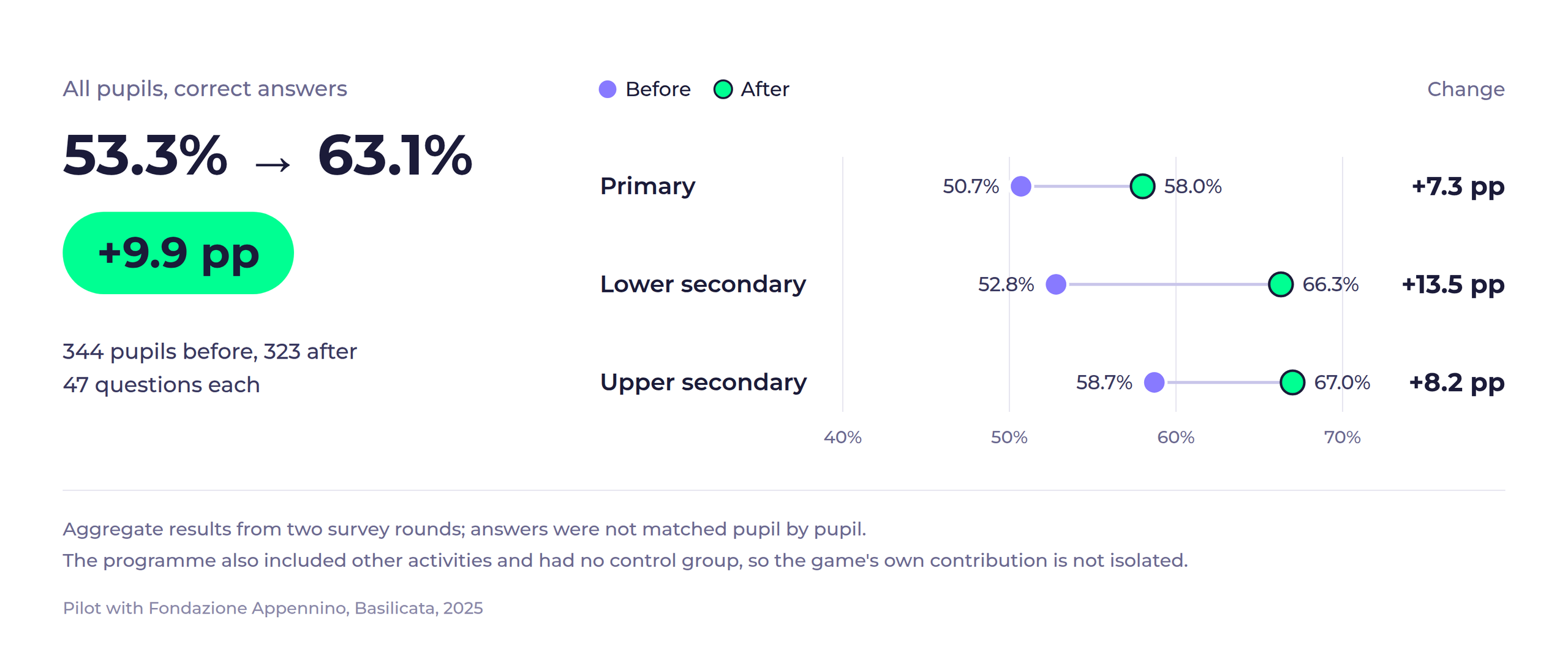
The pilot with Fondazione Appennino shows that, in the schools involved, correct answers rise from 53.3% to 63.1% across 47 questions, between the 344 initial responses and the 323 final ones.
The gain holds at every school level, and it is largest in lower secondary: +13.5 percentage points.
This is an aggregate snapshot: it tells us the programme works in the classroom; establishing how much the game itself contributes takes the second study.
Future teachers: significant gains in knowledge and self-efficacy
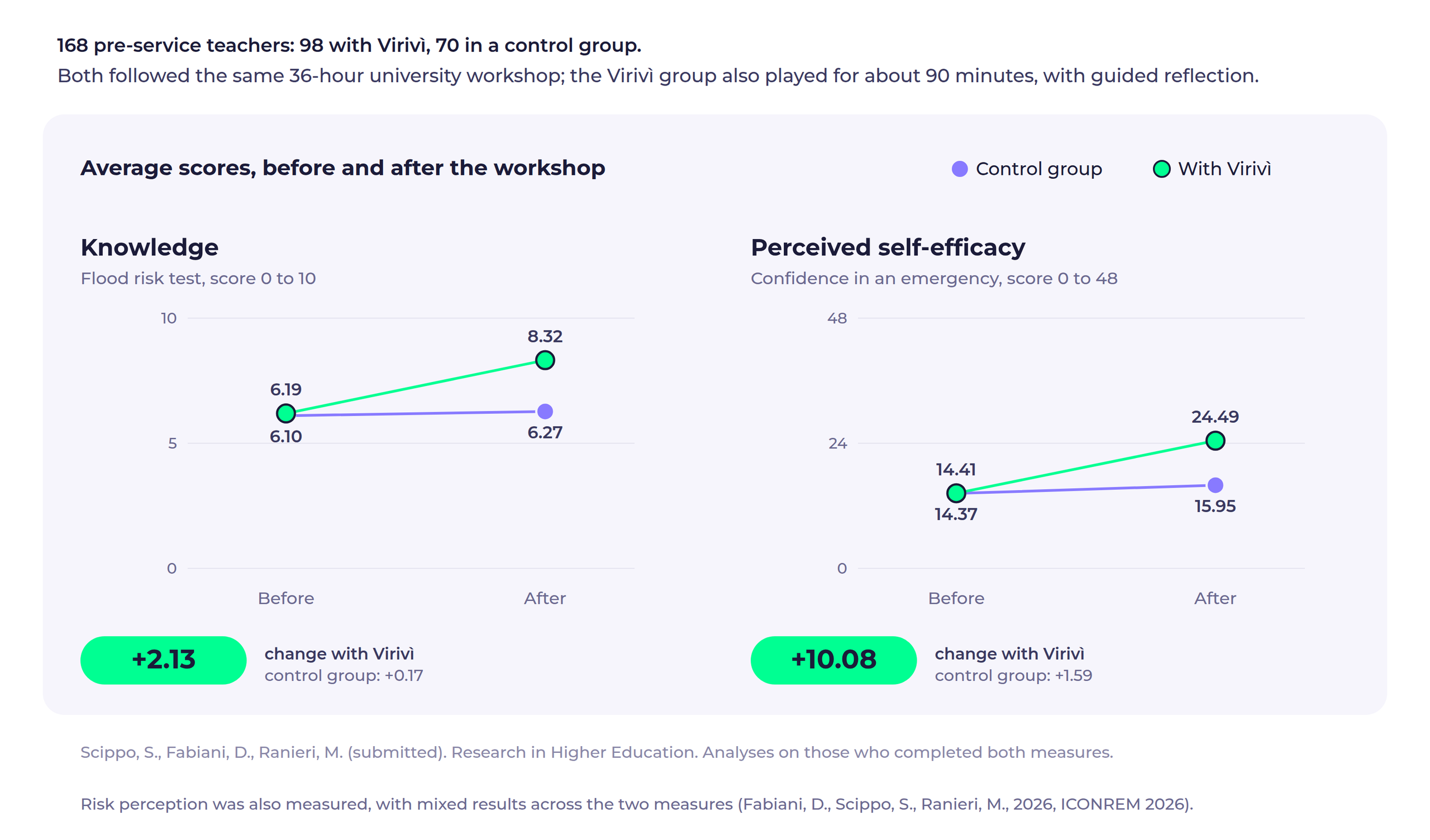
168 pre-service teachers: 98 played, 70 did not. All of them followed the same 36-hour university workshop; the experimental group added about 90 minutes of play and a guided reflection.
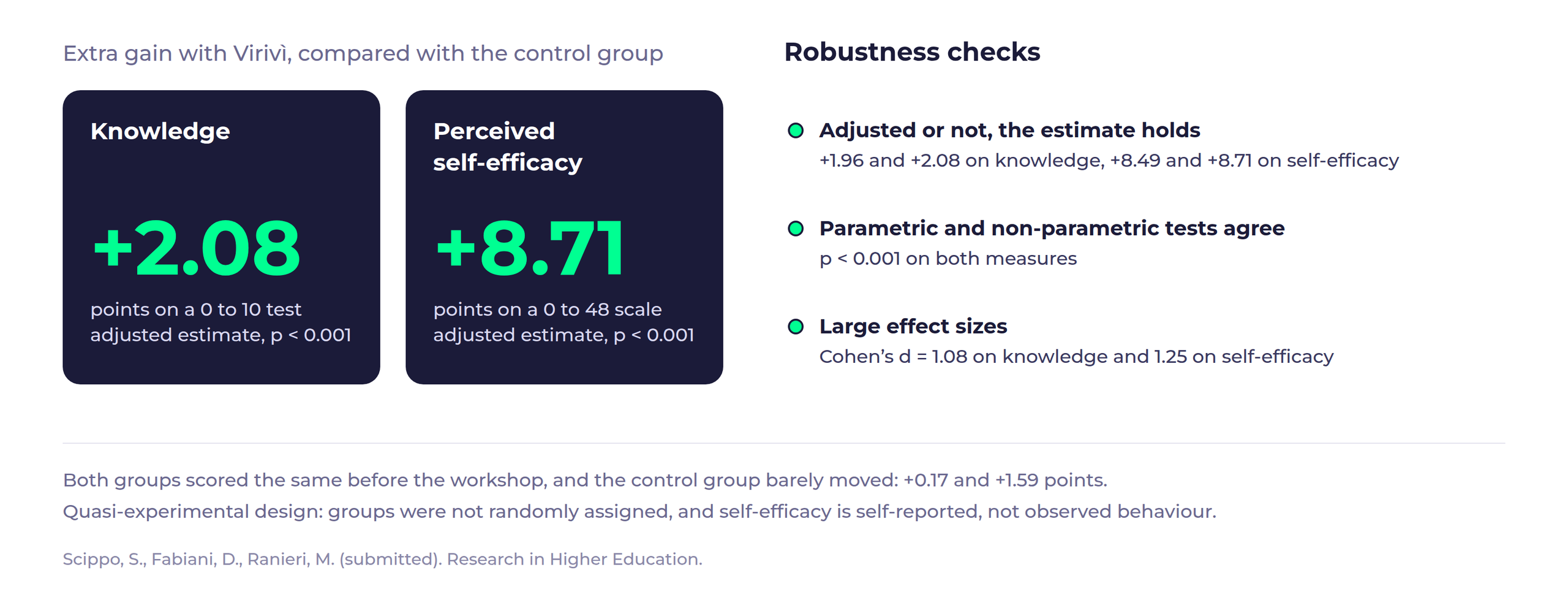
Those who played gained 2.08 points out of 10 on the knowledge test and 8.71 points out of 48 on the self-efficacy scale over and above the control group, with p < 0.001 on both measures. The control group barely moved: +0.17 and +1.59 points.
The comparison says that 90 minutes of play shift self-efficacy far more than the rest of the workshop does on its own: the game proves a valuable addition to the course.
Robustness of the result
The estimate holds with or without adjustment for baseline scores, +1.96 and +2.08 on knowledge, +8.49 and +8.71 on self-efficacy, and parametric and non-parametric tests agree, with p < 0.001 on both measures.
The effect size is good: Cohen’s d = 1.08 on knowledge and 1.25 on self-efficacy..
With margins like these, 90 minutes of play inside an existing course is a small investment for what it shifts. The study ran on our own platform for field research: pre and post questionnaires, cohorts and control groups, nickname sign-in and no personal data collected.